S5 120. Your Podcast Can Change the World — Recorded Live at the Obama Presidential Center
What if the most powerful tool for community change was already sitting in your pocket? Podcasting has slowly yet steadily become one of the most democratic mediums in human history, without gatekeepers, fancy studios, or corporate approval required. All you need is your voice, a story, and a simple microphone.
And nobody understands that better than President Obama. Known as the first digital president for the way he used technology and social media to mobilize millions, he has since become a podcaster himself — proof that even the most powerful platforms in the world have given way to the intimacy of a single human voice.
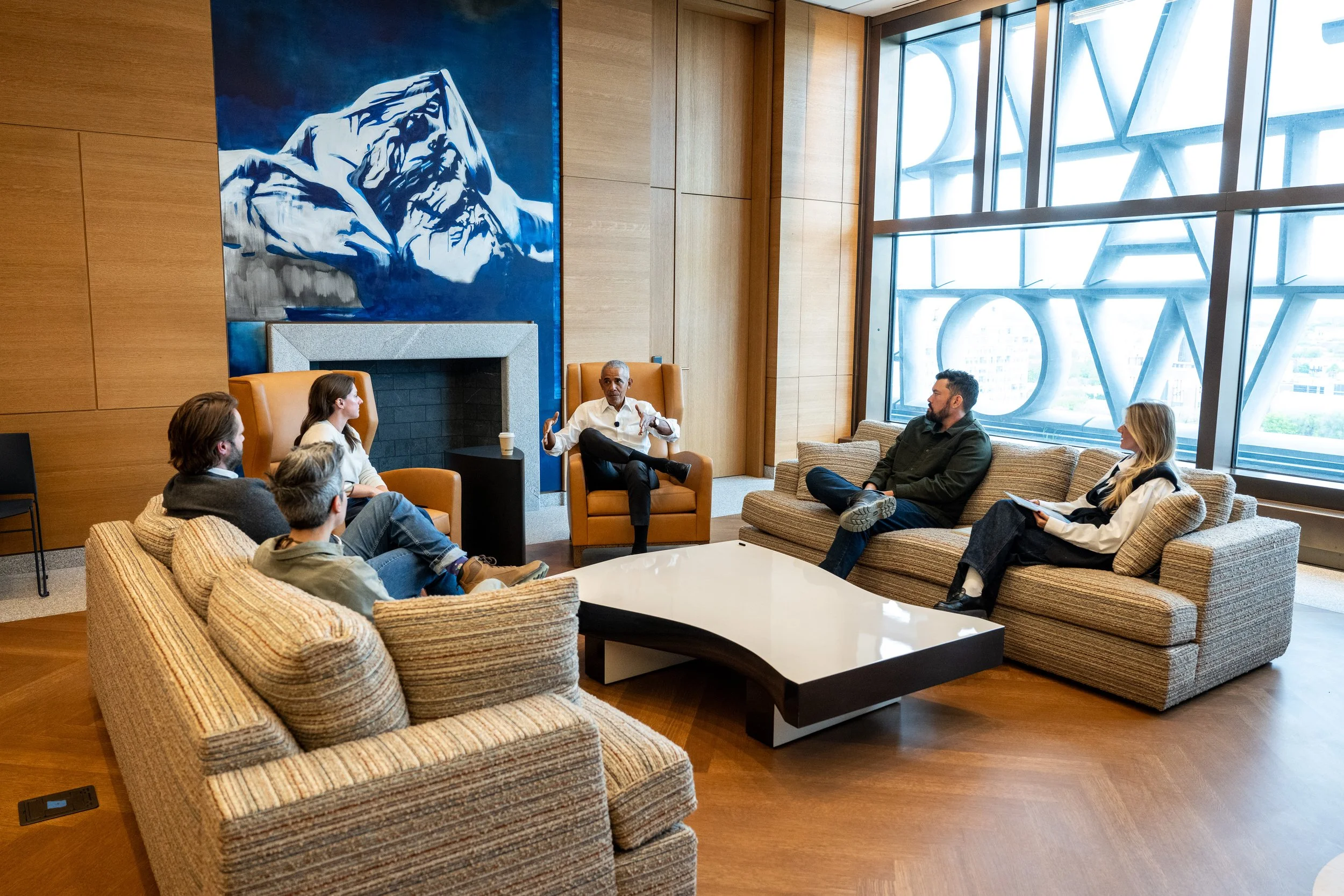
In this episode, I had the extraordinary privilege of joining him at an exclusive roundtable at the Obama Presidential Center in Chicago, where he shared his thoughts on exactly that: why podcasting is one of the most revolutionary tools we have for connection, community, and real-world change.

From left to right: Dave Jorgenson, Ana Xavier, Emily Glankler, President Obama, Kevin Espiritu, Amanda Ferber. Credit: Obama Foundation
Chapters:
00:00 — Podcasting as a tool for meaningful local action
02:49 — Reflections on meeting President Obama
05:19 — The power of the human voice and local stories
11:49 — From inspiration to practical community impact
19:56 — Ten values that turn podcasting into action
Why every story matters
During the roundtable, I asked President Obama how he hopes underrepresented communities — multilingual leaders, women, people who never saw themselves reflected in traditional media — will use the Center's recording studio and creative spaces.
His answer cut straight to the core of why I do this work:
"The power of podcasting is the power of the human voice and the power of stories. And what I love about podcasting is it's got a low barrier to entry. And that is revolutionary. The notion that you've got a story to tell, you get a microphone and you record that story. (...) That's not just the source of great art, it's the source of community and it's the source of social trust and it's the source of ultimately democracy and social cohesion."
With that as our foundation, I then walk you through what it actually looks like to build that kind of impact intentionally. Because inspiration without strategy only gets you so far. One of the first things I tackle is the trust equation: as of 2023, podcasters are ranked as the most trusted influencers on the internet — a remarkable stat in an era defined by misinformation. But that trust is earned slowly and lost quickly. It requires showing up when you said you would, covering what you promised you would, and treating your audience like the community they are rather than a number to grow. Consistency isn't just a content strategy, but it's the foundation of everything.
Podcasting may be digital, but its impact happens in the real world
I also get into what it means to use your show strategically beyond just recording episodes. Your podcast can be a networking tool, a platform for amplifying local voices, a space to practice thought leadership, and a bridge between the digital and the in-person worlds. I've used mine to connect with guests and listeners from around the world — and then meet them face to face. That kind of cumulative, compounding connection is what separates podcasters who build real communities from those who just build content libraries.
From there, I tie it all together using the Obama Presidential Center's own "Hope to Action" values — courage, empathy, integrity, accountability, community, inclusivity, pragmatism, resilience, imagination, and hope — and map each one to the lived experience of podcasting. These aren't purely abstract ideals; they're the skills you develop episode by episode. Courage every time you hit record on a topic that matters to you and isn't covered by traditional media. Empathy every time you interview someone whose world looks nothing like yours. Resilience every time you show up past episode ten, when nearly half of all podcasters have already quit.
Create more, consume less
Finally, I close with something President Obama said (in the extended conversation) that I keep coming back to — his observation that we've been conditioned to be consumers rather than creators, and that the antidote is making things. "We are trained to be consumers as opposed to producers," he said, and it applies directly to why so many people sit on podcast ideas for years without launching. Your show is not just content. It's an act of agency — and this episode is here to help you treat it that way.
If this episode sparked something in you — whether it's the courage to finally launch that show you've been putting off or a fresh perspective on the community you're already serving — I'd love to connect.
Thank you to the Obama Presidential Center for inviting me into this space and for building something that reminds us all: your story is worth telling, your community is worth serving, and your voice — however small it may feel today — is exactly the kind of signal the world needs more of right now. I'll see you in the next episode.
RESOURCES MENTIONED IN THE EPISODE:
To book your visit and learn more about The Obama Presidential Center, its podcast studio and Museum, please head to:
ABOUT THE HOST

Hi, I’m Ana Xavier, a multilingual award-winning podcast marketing and content strategist specialized in generating online visibility for women, multilingual, and minority impact-driven business owners.
Want to keep learning?
Check these episodes next…